
This is a project focusing on not only the behavior of different types of species, but also the behavior and construction way of the materials. The target is to create a food chain rather than a habitat, utilizing the wax, which has typical properties in physics and biology. In the daytime, the whole structure looks like a landscape. At night, with the special night-light, each wax egg declares as a glow, at the same time attracting the insects as well as leading the path for some creatures like geckos. From the prefabricated unit to the whole, the rope structure is the principal line. Using various ways to fix the unit to the site, it is more closely combined with nature.
Mori In Jiyugaoka
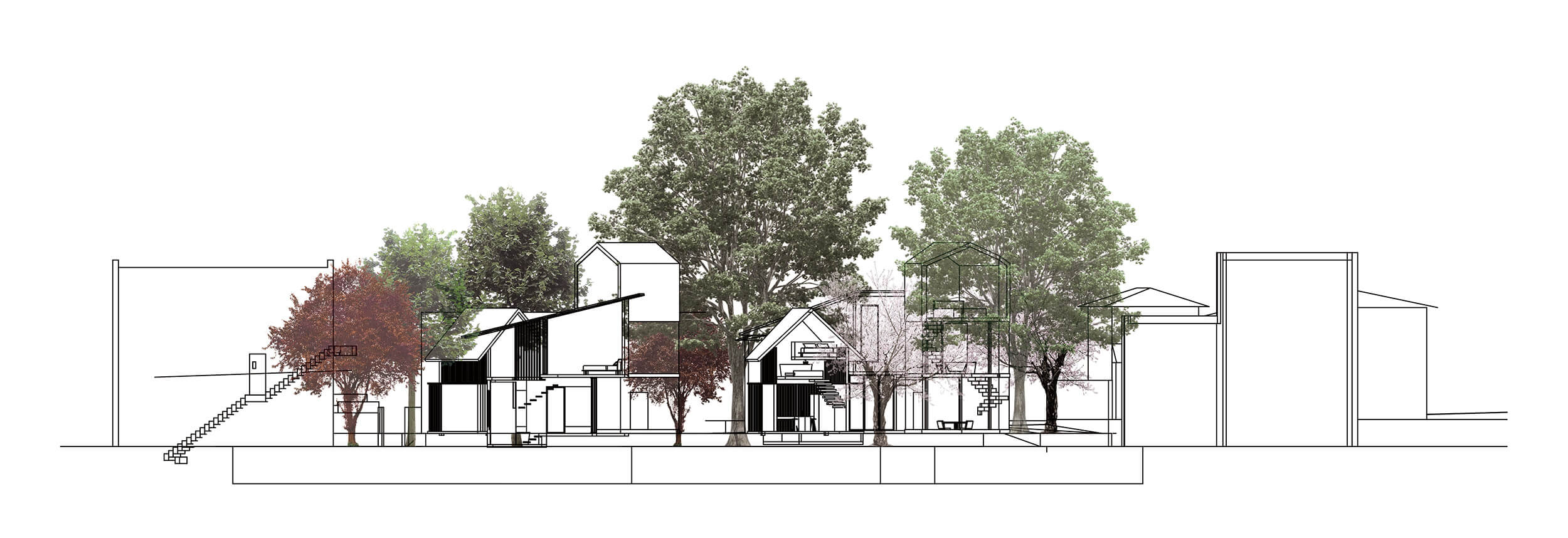
MORI IN JIYUGAOKA
During the mapping of the various activities, we found that Jiyugaoka has a very season- al characteristic. The areas change over time, from morning to evening during the day and from weekdays to weekends.
Jiyugaoka is known for its trendy, fancy and cute shops and cafe’s that are targeted more towards the women and yet promise to offer a quality ‘Den-en-chofu’ lifestyle to its residents.
In our study, we found that there are not that many gardens or green spaces and this inspired us to create an accommodation that allows one to ‘escape’ into a ‘forest’ in the heart of Jiyugaoka.
The design is an accommodation that personifies ‘living in the forest’. It amplifies luxury living in Jiyugaoka and gives its visitors a feeling of sleeping amidst the trees and isolation in the otherwise crowded surroundings. Through our design we wish to bring back this feeling, to show how import- ant it is to get lost in these experiences and just get away from all the hustle and bustle of everyday life and enjoy the solitude while im- mersed in green.
Upstream
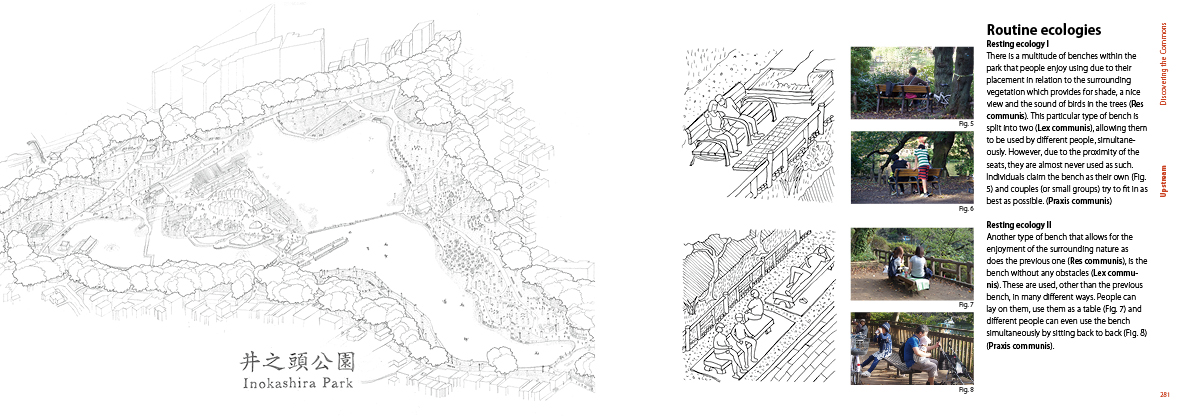
The evolution of the different communis of an ecology typically starts with the available resources, the ʻRes communisʼ. In Inokashira Park, these resources can be considered as the basic foundations of the park. The trees and their shade, the water and its reflection, the birds and their singing – all make up this most primal layer of what can be considered the ʻInokashira Park ecologyʼ. The area of Inokashira Park was formerly restricted to be used solely by the Imperial family. This practice, or ʻPraxis communisʼ, was thus very limited and can even be considered to have been completely restrictive. Only until after the area had been donated to the people and was opened as a park in 1917 were the resources unlocked to the public. But, merely opening a park does not truly make it accessible to the public. Certain facilities, or ʻLex communisʼ, were constructed to allow for the visitors of the park to actually enjoy and experience the Res communis Inokashira Park had to offer. These newly built paths, benched, fences and more, had changed the Praxis communis of the landscape into something that could be practiced by all people visiting. Over time, however, more and more Lex communis was added to the park. Bridges, a variety of benches, many toilets, different paths, restaurants and even a paid zoo and swan-shaped pedalos became a part of the Inokashira Park ecology. Most of these additions did not deal with presenting the resources of the park to its users, however – they simply allowed for the accommodation of many more visitors. Those that did, however, required a fee to access these resources. This is how we encountered Inokashira Park – a theme park for the masses. Having observed the different layers of the three communis of Inokashira Park, simultaneously, we got to understand the way these communis interacted and how much they were dependent on each other. We learned how the practiced Praxis communis was lacking order because of the built Lex communis and, in turn, how the built Lex communis interfered with making the available Res communis accessible to the people. This meant that the Lex communis could be considered the crux within Inokashira Park. Their placements, practicalities and appearances lack consideration regarding its surroundings and usage. By understanding the issues at hand and by analysing its causes, we were able to pinpoint which interventions would have to be made to improve the functionality of the multi-layered ecology of Inokashira Park. Firstly, the built structure of the park is to be clarified and simplified by means of subtraction and adjustment. Certain paths will be removed or redirected; its surface materials changed and their facilities adjusted, so that a smoother flow of the different Praxis communis that are practiced within the park can be realised. As such, these different Praxis communis will be less likely to interfere with each other, without limiting their potential expressions. Secondly, by subtracting certain parts of the park structure, opportunities open up for the placements of new kind of Lex communis. These ʻpocketsʼ will be realised to provide for a better way of experiencing the resources of the park, so that the Praxis communis can truly grasp the Res communis of Inokashira Park.
Performing Arts / Park-Yard
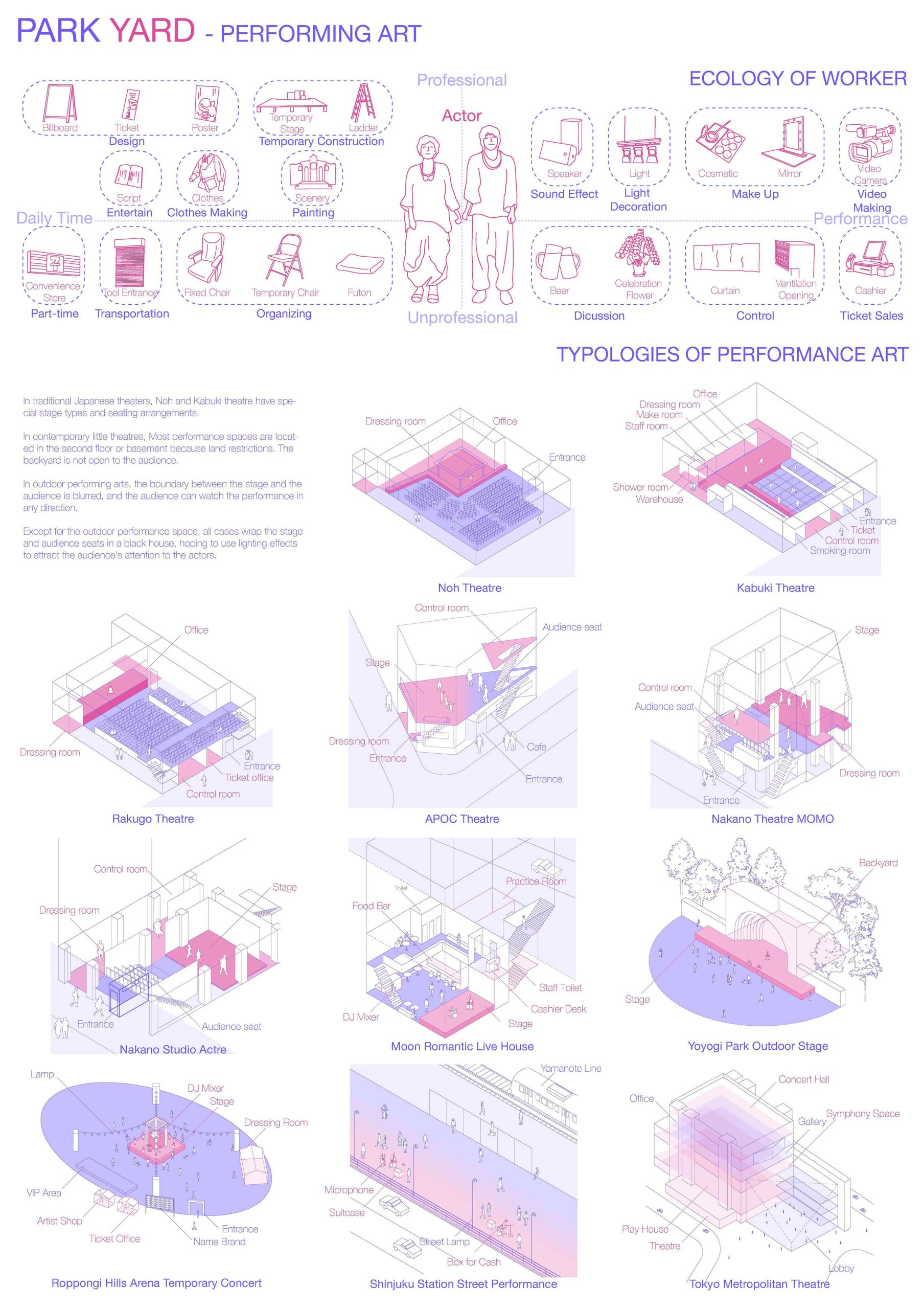
The preparation process of the drama is usually hidden inside a closed small theater, which is only opened during performances. In the Covid-19 situation, a very small amount of performance makes the actor’s life difficult to sustain.
Taking this as an opportunity, we hope to release parts of the functions of the preparation process into the park and the open ground floor space as a workshop, with the intention of opening and displaying the process of drama preparation and sharing skills in cooperation with surrounding residents.
House for Geckos
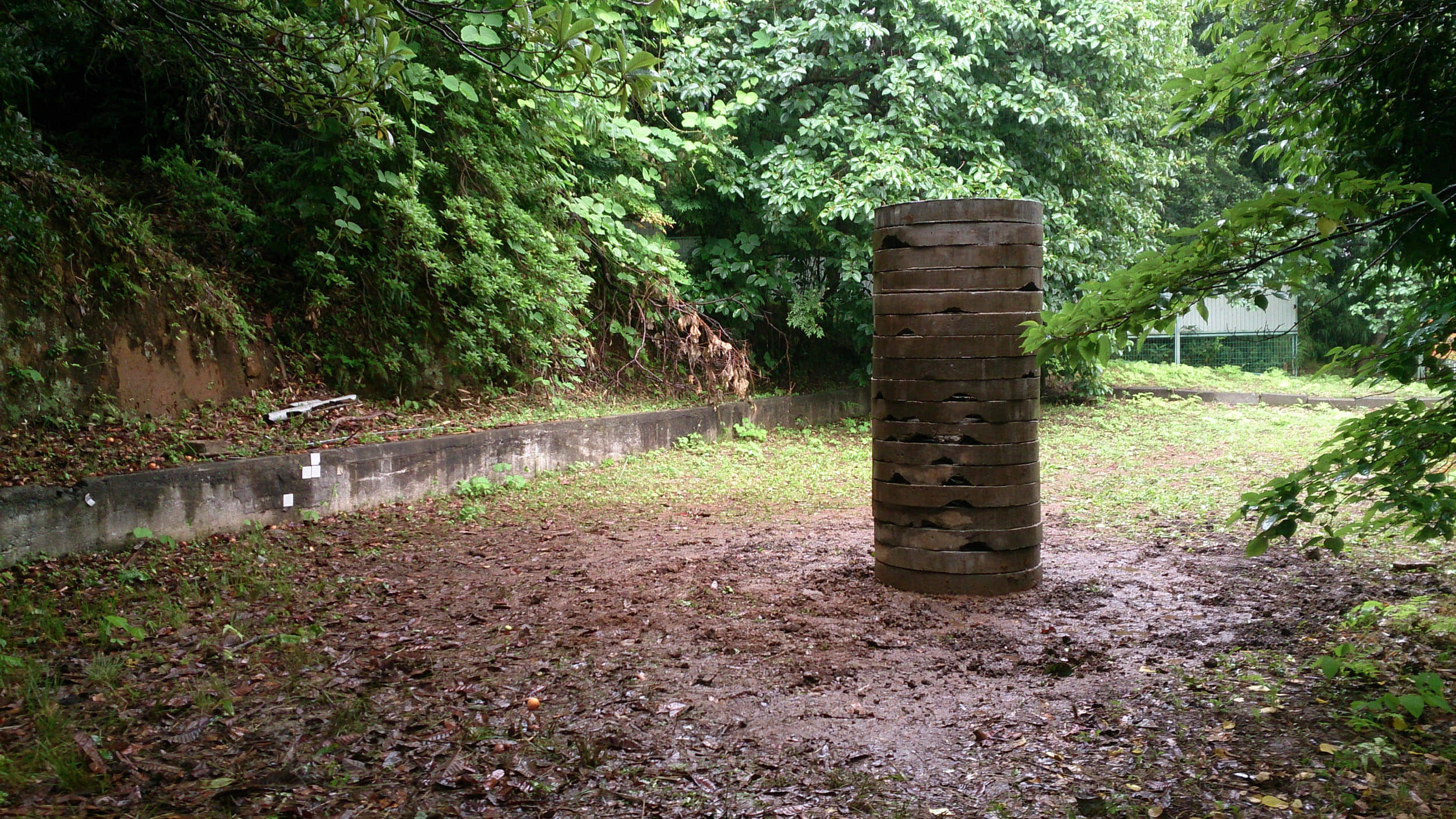
Standing on an open space near Building No.3, this pigeon tower is a new landmark in midorigaoka area and provides a chance to observe animal’s behavior. Through the study of the ecology of pigeon and the typology of pigeon house, a tower is decided for it can protect pigeons from their enemies. From limited materials, plywood is used for the whole tower. The outside skin is a surface structure made by bending and overlapping the plywood. The inside wooden boxes act as individual house for the pigeon and help to support the surface structure. The beam on the top follows the spiral tendencies of boxes and thus points diagonally to the boundary of space. Together with the topography, this creates a dynamic relationship between tower and surrounding.